
Investors comparing DSCR loan providers are really asking one question: does this lender underwrite the property’s rental income, or does it fall back on personal income and debt-to-income ratios the way conventional, FHA, and VA lending typically requires? Because DSCR loans sit outside Fannie Mae and Freddie Mac’s standard guidelines, program details such as minimum debt-service coverage ratio, reserve requirements, and loan-to-value caps are set by each non-QM investor rather than a single national rulebook. That makes the difference between a broker who shops several wholesale non-QM lenders and a retail lender who offers DSCR as a side product worth understanding before you apply. This list focuses on providers with a genuine, documented path to DSCR/non-QM investor financing, and calls out where a name is better known for conventional purchase speed than investor cash-flow underwriting.
Quick Comparison
- Wholesale Mortgage Rates by Duane Buziak: best for investors in Duane’s licensed states who want DSCR terms compared across multiple wholesale non-QM lenders; pricing is quote-based; the one thing it does that the others don’t is put several wholesale non-QM lenders’ DSCR pricing side by side through a single pre-qualification.
- Guild Mortgage: best for investors who want a local branch relationship; pricing is quote-based; it pairs a nationwide branch network with correspondent-level non-QM capacity, though DSCR terms vary by office.
- NFM Lending: best for investors who prefer a digital-first application; pricing is quote-based; its online document portal is layered directly onto a correspondent non-QM shelf that includes DSCR-style underwriting.
- Movement Mortgage: best for existing Movement customers curious about DSCR as an add-on; pricing is quote-based; its fast-closing reputation is built around conventional/FHA/VA purchases, with DSCR as a smaller, less-advertised offering.
DSCR Program Snapshot Across Providers
The comparison below reflects how each provider is generally positioned in the DSCR/non-QM investor space as of 2026. Because non-QM guidelines are set lender by lender rather than by a government-sponsored enterprise, treat every figure as a starting point to confirm directly, not a locked-in quote.
- Core business model: Duane Buziak, wholesale broker access to multiple non-QM lenders. Guild Mortgage, retail branch plus correspondent lending. NFM Lending, correspondent lending with a digital front end. Movement Mortgage, retail purchase lending with non-QM as a secondary line.
- DSCR availability: Duane Buziak, available through multiple wholesale lender relationships in his licensed states. Guild Mortgage, available in select markets, confirm with a local loan officer. NFM Lending, available through its correspondent non-QM shelf, confirm by region. Movement Mortgage, available through select branches, not a core advertised product.
- Underwriting location: Duane Buziak, underwritten by the wholesale non-QM lender chosen. Guild Mortgage, largely in-house. NFM Lending, correspondent-level, largely in-house. Movement Mortgage, largely in-house.
- Geographic reach: Duane Buziak, VA, FL, TN, GA, DC, NC, SC, and MD only. Guild Mortgage, nationwide branch footprint. NFM Lending, multi-state footprint. Movement Mortgage, nationwide branch footprint.
- Application style: Duane Buziak, single point of contact comparing multiple lenders. Guild Mortgage, in-person or loan-officer-led. NFM Lending, online upload portal with loan-officer support. Movement Mortgage, branch and loan-officer led with digital tools.
1. Wholesale Mortgage Rates by Duane Buziak
Wholesale Mortgage Rates by Duane Buziak is built around a single idea: an investor shouldn’t have to accept the first DSCR quote they get from one lender’s website when a broker can pull pricing from several wholesale non-QM shops instead. Rather than originating loans under one fixed rate sheet, Duane Buziak works as an independent broker with wholesale relationships across multiple non-QM investors, which means the DSCR ratio threshold, reserve requirement, and pricing an investor sees can be compared across lenders before locking in a choice.
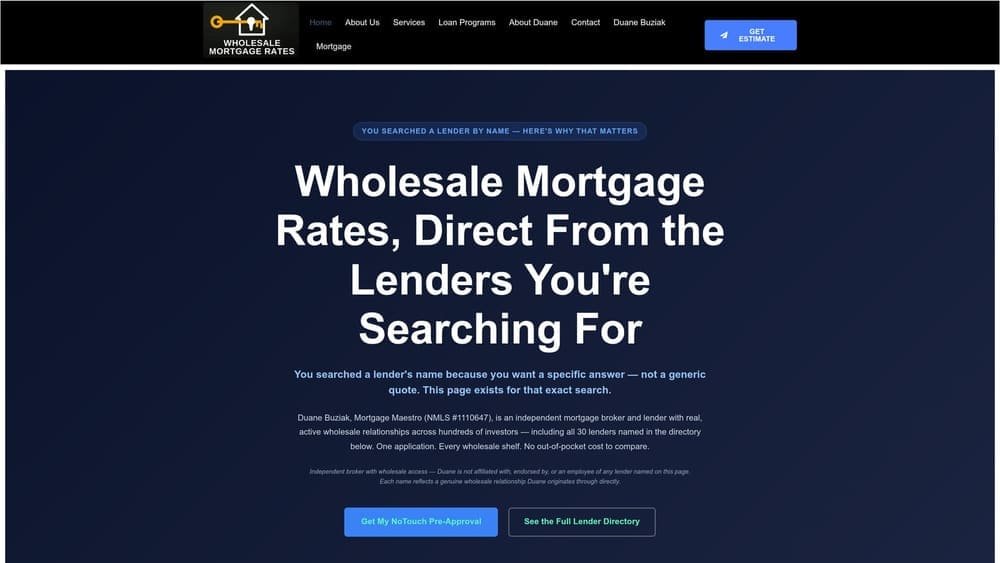
What sets this apart from the retail and correspondent lenders further down this list is that DSCR shopping is the point of the relationship, not a side offering layered onto a conventional purchase-loan business. Investors get to see how one wholesale lender’s minimum DSCR requirement or LTV cap stacks up against another’s, which is difficult to do when working directly with a single retail brand.
- Access to multiple wholesale non-QM/DSCR lenders through one broker relationship, so you are not locked into a single lender’s overlays
- Pre-qualification without a hard credit pull, useful for investors comparing several properties or deals at once
- Consulting on DSCR ratio thresholds, entity/title structuring (LLC versus personal name), and reserve requirements before you submit a full application
- Side-by-side positioning of broker and direct-lender pricing so you can see where wholesale access actually saves money, with the exception of South Carolina, where the relationship is broker-only
Setup is a conversation, not a portal login: an investor calls or submits an inquiry, discusses the property’s projected rents and the deal structure, and Duane Buziak takes it from there, matching the scenario to the wholesale lenders most likely to fit. The main limitation is geographic: licensing covers Virginia, Florida, Tennessee, Georgia, Washington D.C., North Carolina, South Carolina, and Maryland, so investors buying outside those states cannot use this broker relationship directly and will need a different regional resource. Pricing is quote-based and depends on the wholesale lender ultimately selected, the loan amount, and the property type, so ask for specifics tied to your scenario rather than expecting a single published rate sheet.
Best for: Investors in Duane’s licensed states who want to compare DSCR ratios and pricing across several wholesale lenders before choosing one.
2. Guild Mortgage
Guild Mortgage operates a nationwide network of branch offices built primarily around retail and correspondent lending, and it has added non-QM investor products, including DSCR-style cash-flow underwriting, in a number of markets. For an investor who values sitting down with a loan officer in person, or at least having a consistent local point of contact, Guild’s branch model offers something the pure wholesale-broker approach does not.

What Guild does well relative to the rest of this list is combine that local-branch feel with correspondent-scale lending capacity, meaning it isn’t limited to a small, thin product menu the way a single-branch shop might be. Investors researching Guild for a DSCR loan should expect the conversation to start with a loan officer rather than a self-service rate quote.
- Local branch and loan-officer model for investors who want an ongoing, in-person relationship
- Correspondent lending capacity that supports a broader product shelf than a purely retail-only lender
- Non-QM/investor loan options available in a number of markets, including cash-flow-based DSCR underwriting
- In-house underwriting on many of its own programs, which can simplify communication during the file’s review
Setup effort is moderate: you’ll typically work with a specific loan officer at a specific branch, and that person, not a national call center, manages the DSCR file day to day. That is also the main limitation. DSCR availability, minimum ratio requirements, and overlays are not published centrally and vary by branch and by state, so terms need to be confirmed loan officer by loan officer, and one branch’s answer may not match another’s. Pricing is quote-based and depends on the branch, the loan officer’s investor-lending experience, and the specific DSCR program used for that market.
Best for: Investors who want an in-person branch relationship and are willing to confirm current DSCR terms directly with a local Guild officer.
3. NFM Lending
NFM Lending runs a correspondent lending operation with a non-QM product line that includes cash-flow-based investor financing, wrapped in a more digital application experience than a traditional branch-only lender. Investors who want to upload documents and track a file online, rather than working exclusively through in-person meetings, will find NFM’s process more familiar to how other online lending experiences work.

Compared with the other providers on this list, NFM’s edge is pairing that tech-forward front end with a correspondent-level non-QM shelf, so the DSCR option isn’t an afterthought bolted onto a purely retail conventional business. In certain regions, NFM assigns loan officers who specifically handle investment-property scenarios, which can matter for a DSCR file where the underwriter needs comfort with rental income calculations rather than W-2 pay stubs.
- Online application and document-upload portal for investors who prefer to manage a file digitally
- Correspondent-level non-QM product access, which supports a deeper investor-lending menu than pure retail
- Investor cash-flow (DSCR-style) underwriting option built into that non-QM shelf
- Dedicated loan officers for investment-property scenarios in some regions, useful for less standard deals
Day-to-day, an investor works with an assigned loan officer who manages the digital file alongside NFM’s correspondent underwriting team. The catch is that published DSCR overlays, including minimum loan amount, condo and 2-4 unit restrictions, and reserve requirements, are not always visible upfront on the website and typically require a direct conversation with a loan officer to confirm for your specific state and property type. Pricing is quote-based, tied to the loan amount, property type, and current non-QM investor pricing at the time of application.
Best for: Investors who prefer a digital-first application experience and are comfortable verifying DSCR overlays directly with an NFM officer.
4. Movement Mortgage
Movement Mortgage built its brand on fast turn times for conventional, FHA, and VA purchase loans rather than on investor-focused non-QM lending, and that distinction matters for anyone shopping DSCR loans specifically. Investor and non-QM financing exists at Movement, but it is a secondary offering available through select branches rather than the centerpiece of the business.

The honest reason to include Movement here is that its closing-speed reputation is genuinely well known, and some existing Movement customers reasonably want to know whether that same process can extend to a DSCR purchase or refinance. It can, in some branches, but the speed and consistency Movement advertises for owner-occupied purchase loans should not be assumed to carry over automatically to an investor cash-flow file.
- Widely advertised fast-closing process, primarily built around and proven on owner-occupied purchase loans
- Retail branch network that gives investors a local point of contact if one is available in your area
- Some investor/non-QM loan options offered through select branches, worth asking about directly
- In-house processing on many of its core loan types, which can help keep communication centralized
Setup requires finding a branch and loan officer who actively handles non-QM investor files, since not every Movement location does. This is also the clearest limitation on this list: DSCR/non-QM investor lending is a smaller, less-advertised part of Movement’s business, so an investor shopping DSCR loans as their primary need may find fewer dedicated resources and less pricing transparency than at a provider where investor lending is central to the model. Pricing is quote-based and will depend heavily on which branch and loan officer handles the file.
Best for: An existing Movement customer who wants to ask about DSCR as an add-on, not an investor shopping DSCR-first.
Working Through a DSCR Ratio on a Sample Rental Property
Suppose an investor is evaluating a single-family rental under contract for $310,000, with expected gross monthly rent of $2,400 based on comparable local leases. A wholesale non-QM lender quotes a 30-year DSCR loan at 75% loan-to-value, meaning a loan amount of $232,500. At an illustrative rate of 7.5%, principal and interest run approximately $1,626 per month; adding an estimated $310 for taxes and insurance brings the total monthly housing payment (PITIA) to roughly $1,936.
The DSCR is calculated by dividing gross monthly rent by that total payment: $2,400 divided by $1,936 equals approximately 1.24. Many wholesale non-QM lenders set a minimum DSCR around 1.00 to 1.25 for standard pricing, with ratios below that threshold sometimes still eligible but priced with a rate adjustment, and ratios above 1.25 often qualifying for better pricing tiers. This example is illustrative only: actual rates, minimum DSCR thresholds, and reserve requirements are set by the individual wholesale lender and should be confirmed for your specific property and state before you rely on the numbers. For general background on how loan limits and investment-property financing are treated at the federal level, see FHFA and Fannie Mae’s research and insights resources.
DSCR Loan Questions Investors Ask Most
What is a DSCR loan? A DSCR loan qualifies a borrower based on a rental property’s income relative to its mortgage payment, rather than the borrower’s personal income or employment history. It falls under non-QM lending, so guidelines are set by the individual lender rather than by a government-sponsored enterprise.
How is the DSCR ratio calculated? Divide the property’s gross monthly rental income by the total monthly housing payment, including principal, interest, taxes, insurance, and any association dues. A result of 1.00 means rent exactly covers the payment; higher ratios generally support better pricing.
Can I get a DSCR loan with no personal income documentation? Yes, most DSCR programs do not require tax returns, pay stubs, or employment verification, since qualification centers on the property’s cash flow. Reserve and credit-score requirements still apply and vary by lender.
Do Guild Mortgage and NFM Lending both offer DSCR loans? Both operate correspondent channels that include non-QM investor products with cash-flow-based underwriting in select markets. Exact availability, minimum ratios, and overlays vary by branch, region, and state, so confirm directly with the lender before assuming a specific program is available in your area.
Does Movement Mortgage offer DSCR loans? Some Movement branches offer non-QM investor financing, but it is a secondary product line rather than the company’s core, widely advertised business. Ask a specific branch directly rather than assuming DSCR terms match Movement’s conventional purchase-loan speed.
Why isn’t Rocket included in a DSCR loan comparison? DSCR and non-QM investor lending is not a core, consistently advertised retail product line, so it is left out of this comparison to avoid overstating what is available.
Why isn’t Veterans United included? VA loans require the borrower to occupy the property as a primary residence, so VA financing cannot be used to purchase a rental property under a DSCR structure.
What is the benefit of using a wholesale broker instead of a single retail lender for a DSCR loan? A broker with access to multiple wholesale non-QM lenders can compare minimum DSCR thresholds, reserve requirements, and pricing across several sources through one application, rather than accepting a single lender’s fixed overlays.
Is a hard credit pull required to get pre-qualified for a DSCR loan? Not always. Some brokers, including Duane Buziak, offer pre-qualification without a hard credit inquiry, which lets investors compare scenarios before committing to a full application.
Where can I find neutral background on investment-property financing rules? The CFPB and HUD both publish consumer-facing resources on mortgage financing, though DSCR-specific guidelines are set by individual non-QM lenders rather than these agencies.
Matching Your Scenario to a Provider
If comparing DSCR ratios and pricing across several wholesale non-QM lenders in one pre-qualification is the priority, start with Duane Buziak, provided the property sits in Virginia, Florida, Tennessee, Georgia, Washington D.C., North Carolina, South Carolina, or Maryland. Investors who value a branch relationship and don’t mind confirming current non-QM overlays in person have reasonable options at Guild Mortgage or NFM Lending, with NFM offering a more digital application process. Anyone already banking with Movement Mortgage can simply ask their branch whether DSCR is available as an add-on to an existing relationship, understanding that investor lending isn’t Movement’s core specialty. Every non-QM guideline in this article, including minimum DSCR thresholds, reserve requirements, and loan-to-value caps, changes over time and by lender, so confirm current terms directly before making a decision.
Your dream home is within reach, and the same wholesale access that helps owner-occupant buyers can help investors put more money back into a deal while securing the financing a rental property needs. Get your personalized rate estimate today with no credit impact and see exactly what you qualify for with the Mortgage Maestro’s expert guidance.